Assistive Devices, Technology or Positioning
A major consequence for people with SCI is mobility impairment, which can make positioning and cradling a baby while breastfeeding challenging. In high-level SCI, weakness in the upper arms may necessitate the use of a wrap, harness, support cushion, partner, family member or care aide to help with holding the baby. Although upper arm motor function is preserved in individuals with low-level SCI, impaired trunk stability may contribute to difficulties with breastfeeding. Specific supports that can help with breastfeeding may include setting up the mother’s chair to care for her baby, as well as training family members to assist with positioning and latching the baby (Cowley, 2007; Gragg, 2015).
*For demonstration of Assistive Devices and Positioning for Breastfeeding, see this video on our YouTube channel.
*For a guide to assistive devices and positioning for sexual activity, please go to the PleasureABLE Sexual Device Manual for Persons with Disability.
Discussion
Though research on assistive devices is limited, there is some knowledge available with regards to specific adaptations that are helpful for mothers with SCI. Most of remaining motor and sensory function will be determined by the level and completeness of injury; for example, the ‘let-down’ reflex that allows milk to flow is innervated at T6.
Special attention to the following aspects of motherhood, pregnancy, breastfeeding, and daily functioning for moms with SCI include:
Breastfeeding
- Accessibility, positioning, and mobility concerns will be based on level of SCI, with hand/arm function innervated at the cervical level.
- Achieving an adequate latch is most possible with good positioning, which may take time, practice, or assistance for mothers to establish. Limited hand and arm mobility following SCI can complicate this process, with special attention required for the following aspects.
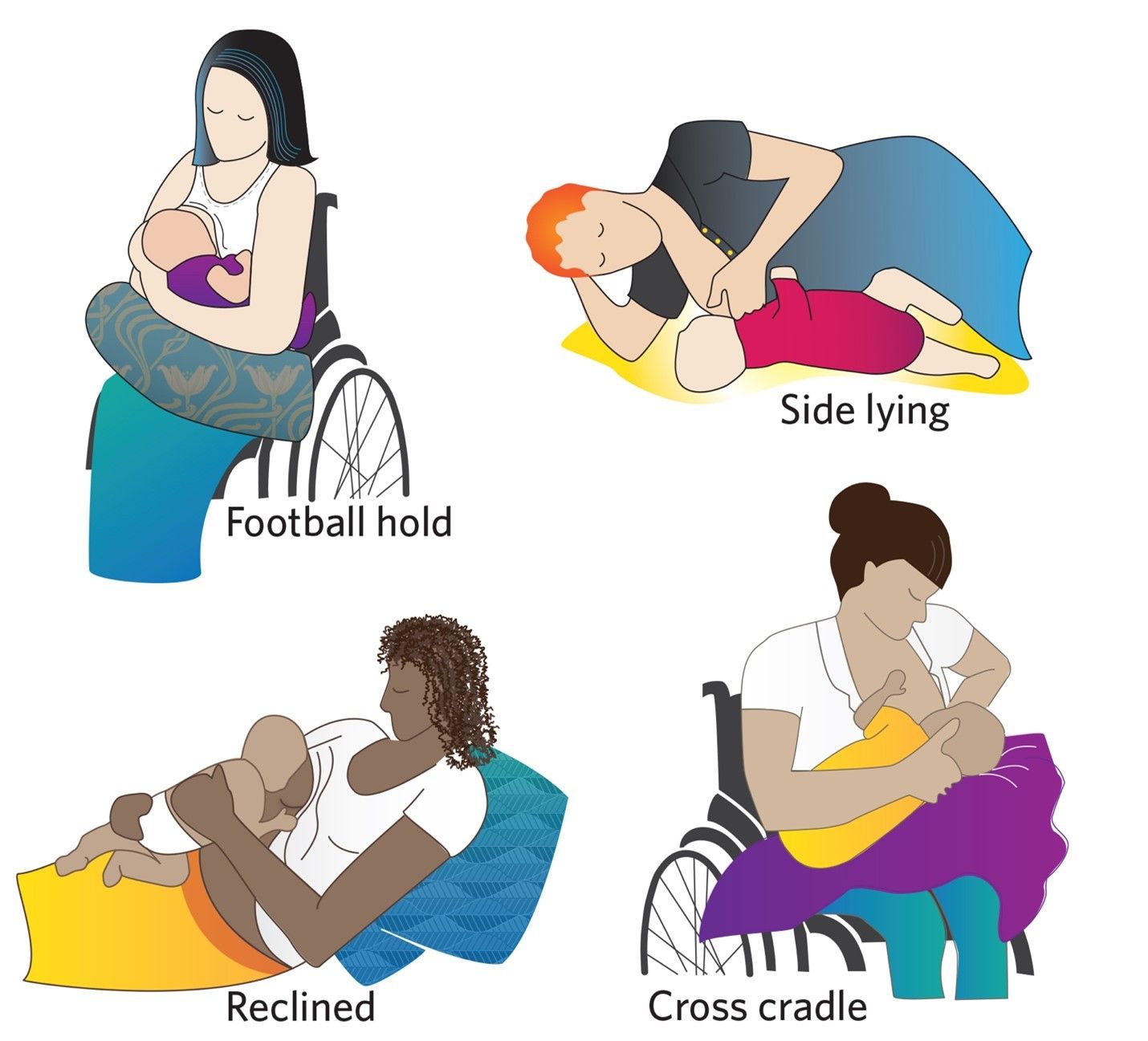
- Often, the most successful breastfeeding positions for mothers with SCI are side-lying, football hold, reclined position using a wedge pillow, or using a ‘breast-friend’ pillow allowing for baby to be safely placed on mother’s lap (see image below).
- For complete review of ability to breastfeed following SCI, see Breastfeeding and Impaired Lactation page.
Access to Baby
- Impaired motor recruitment of arm, shoulder, or core muscles may affect a mother’s ability to lift or hold a child or to retrieve a child from lower surfaces (such as a crib, change table, floor).
- Assistive baby equipment, like a sling to assist lifting baby off the floor, height-adjustable high-chairs, slide-down cot sides and prams that are easy to fold and push with one hand can help a mother with SCI attend to baby independently (Hunter & Coventry, 2003).
Bed mobility
- Challenges will depend on the level of injury and its impact on hand function, arm strength, trunk control, and/or core strength. These limits in function may significantly impact a mother’s ability to roll, move from lying to sitting, and pick up, lift, position, and hold the child even when the child is lying in bed with them. Bed mobility may become particularly more challenging in the later stages of pregnancy and the early postpartum period due to weight gain, child’s position, increased spasms, and fatigue.
- Consideration should be given to exploring sleeping arrangement possibilities that increase mother’s ease of access prior to the child’s arrival. Safe co-sleeping options may include the use of a bassinet or a crib adjacent to the mother’s bed, or modifying the height of the changing table.
- Experts suggest minimize the distance and height between mother and child during the night to reduce the need to transfer for feeding and resultant fatigue. Practicing transfer and carrying routines is also important to the safety of mother and child.
Transfers
- Transfers may become increasingly difficult during pregnancy and postpartum due to pregnancy-related weight gain, increased spasms, decreased ability to shift weight forward during transfers, altered centre of gravity, and fatigue. Aids to assist transfers include a slide board and/or temporary hoists for transfers to and from bed, toilet, and/or car.
- After birth, transfers may be challenging due to healing post vaginal/Caesarean delivery. This is compounded by the higher frequency of transfers per day to meet increasing care demands. Some women with SCI have reported becoming so afraid of falling during pregnancy that they changed their behaviors, such as starting to routinely use transfer boards or limiting their activities (Iezzoni et al. 2016).
Wheelchair Modifications
- Wheelchair modifications may be required to allow for additional trunk support, accommodate increased weight and space for baby, and better stability while lifting and holding the child. One qualitative study reported that the majority of participants had difficulties with wheelchair fit, maneuverability or stability (Iezzoni et al. 2015b). These problems affected the women by reducing their mobility; increasing their risks of wheelchair tipping and causing falls or other injuries; causing difficulties transferring from one surface to another; and causing problems with skin shear and/or pressure ulcers (PU) at vulnerable pressure points.
- Adjusting the seat slope or backrest angle can change the mother’s center of gravity and improve stability. A backrest with deeper lateral trunk support will also add stability.
- Many mothers with SCI benefit from using a modified breastfeeding pillow (e.g., ‘breast-friend’ pillow) or child carrier with a long waist strap that also wraps around the wheelchair backrest, which reduces their tendency to lean forward while holding the weight of the child in front.
Activities of Daily Living (ADLs)
- Mothers with SCI still have to attend to their own ADLs like dressing, feeding, toileting, and pressure relief.
- With additional weight during and post-pregnancy, there may be changes required in pressure relief. Experts suggest reviewing existing cushion/mattress or pressure-lifting techniques.
Spasticity
- There may be increased or changed spasticity both during and after pregnancy, which may impact the duration of breastfeeding or skin-to-skin contact time.
- Mothers may need to explore alternative positions for holding their child for extended periods of time. This may include sitting up in bed with pillows, using an adjustable bed, or sitting in wheelchair with a breastfeeding pillow to provide support and enhance balance.
- Experts suggest consulting the appropriate HCPs for any necessary changes in spasticity management (e.g., botulinum toxin is not recommended to take while breastfeeding).
*All of the above recommendations are adapted from Krassioukov et al. 2024 and Krassioukov et al. 2023; other contributing research is cited throughout.
It will be important to consult with a physical therapist (PT), occupational therapist (OT), nurse/lactation consultant, and other medical SCI expertise when trialing any assistive device, technology, new positions, or transfer technique. Pre-conception planning and in-depth discussions during early pregnancy are recommended to anticipate and address future mobility difficulties. Breastfeeding plans should include considerations for balancing personal care, night feeds, and mobility challenges.
Conclusion
Appropriate supports, assistive aids, and positions exist to support mothers with SCI. These include transfer techniques, slide boards, pillows, height-adjustable changing tables and cribs, as well as wheelchair and bed modifications. Larger studies with more participants and studies that specifically test the efficacy of assistive devices would be helpful in generating more knowledge on the best supports for breastfeeding after SCI.