Measurement Property Summary
# of studies reporting psychometric properties: 1
Interpretability
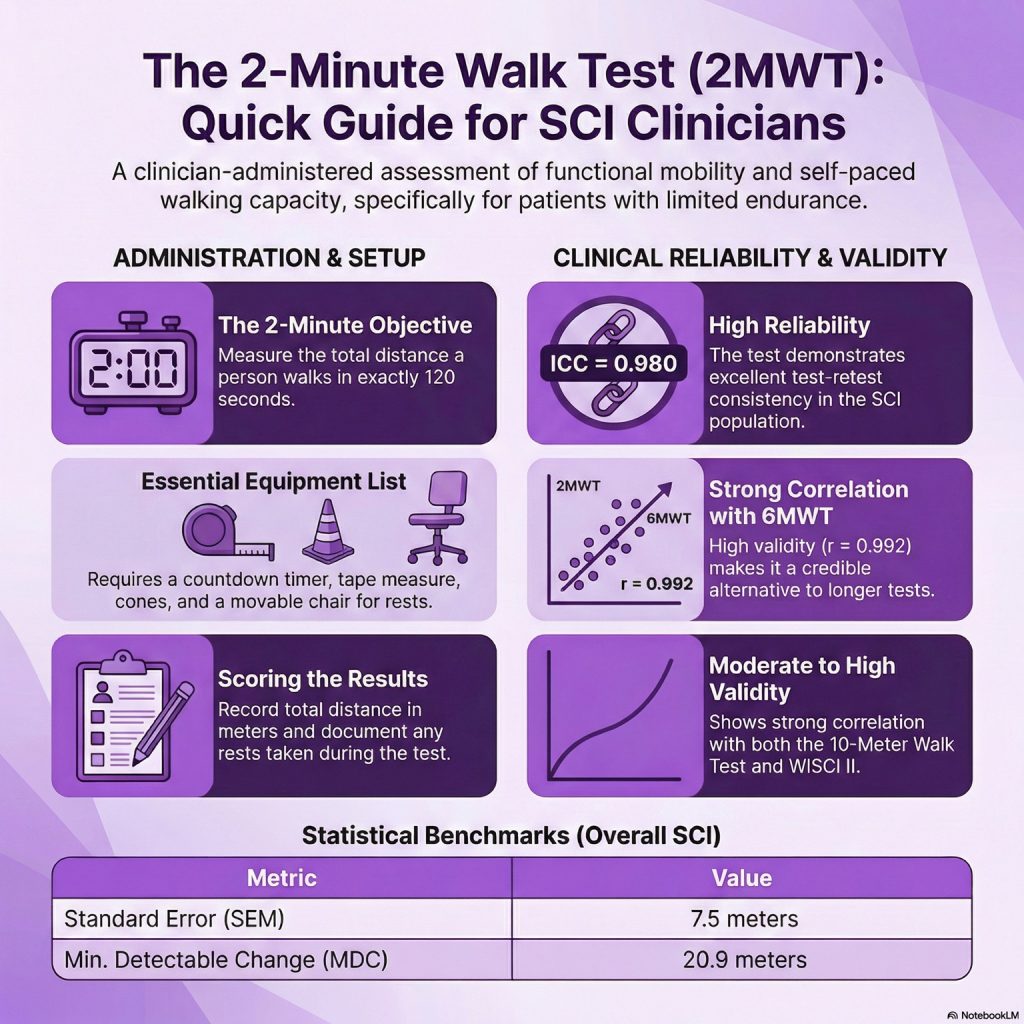
MCID: not established in SCI.
SEM:
- 7.5 m (overall)
- 8.5 m (slow walkers)
- 7.3 m (fast walkers)
MDC:
- 20.9 m (overall)
- 23.6 m (slow walkers)
- 20.3 m (fast walkers)
(Willi et al. 2023; n=50; 33 males, 17 females; mean (SD) age: 52.6 (16.3) years; ASIA A-D; 24 tetraplegia, 26 paraplegia; mean time since injury 6.11 years)
Reliability – High
Test-retest reliability is High for the 2-MWT (ICC = 0.980).
(Willi et al. 2023; n=50; 33 males, 17 females; mean (SD) age: 52.6 (16.3) years; ASIA A-D; 24 tetraplegia, 26 paraplegia; mean time since injury 6.11 years)
Validity – Moderate to High
- Correlation between the 6-MWT and the 2-MWT is High (r = 0.922).
- Correlation between the 10-MWT and the 2-MWT is High (r = 0.932 – 0.964).
- Correlation between the WISCI II and the 2-MWT is Moderate to High (r = 0.571 – 0.749).
- Correlation between the SCI-FAI and the 2-MWT is High (r = 0.688 – 0.805).
- Correlation with the Berg Balance Scale and the 2-MWT is High (r = 0.781).
- Correlation with the TUG test and the 2-MWT is High (r = -0.623).
(Willi et al. 2023; n=50; 33 males, 17 females; mean (SD) age: 52.6 (16.3) years; ASIA A-D; 24 tetraplegia, 26 paraplegia; mean time since injury 6.11 years)
(Lemay & Nadeau 2010; n=32, 25 males, 7 females; mean (SD) age: 47.9 (12.8) years; ASIA D; tetraplegia and paraplegia; mean (SD) time since injury: 77.2 (44.3) days)
Responsiveness
No values were reported for the responsiveness of the 2MWT for the SCI population.
Floor/Ceiling Effect
No values were reported for the presence of floor/ceiling effects in the 2MWT for the SCI population.
Reviewers
Dr. Janice Eng, Dr. Carlos L. Cano-Herrera, Matthew Querée.
Date Last Updated
31 December 2024